Many machine shops have experienced the same frustrating problem.
A 34CrNiMo6 (1.6582) round bar looks perfectly straight when it arrives. The straightness is within specification. However, after rough turning or removing a significant amount of material, the bar suddenly bends.
The machinist immediately asks:
- Is the steel defective?
- Is the forging quality poor?
- Is the heat treatment incorrect?
- Or is something else happening inside the material?
The answer is usually residual stress.
In this article, we’ll explain why 34CrNiMo6 round bars distort during machining, how residual stress develops, how straightness standards work, and most importantly, how buyers can minimize machining deformation.
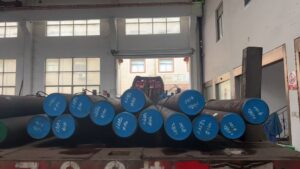
Why Does a Straight Round Bar Bend After Machining?
This is probably the most misunderstood issue in steel processing.
The answer is simple:
The bar was straight before machining, but the internal stress was not balanced.
Think of the steel like a compressed spring.
Although the outside looks perfectly straight, internal stresses are “locked” inside the material.
When machining removes material from one side, the stress balance changes.
The remaining material begins to redistribute stress.
The result?
The bar bends.
What Is Residual Stress?
Residual stress is internal stress that remains inside steel after manufacturing.
No external force is applied.
The stress already exists.
Residual stress mainly comes from:
Forging
Large deformation during forging creates uneven plastic deformation.
Heat Treatment
Quenching creates different cooling rates.
The outer surface cools first.
The center cools later.
Different expansion and contraction generate stress.
Straightening
After heat treatment, round bars are often mechanically straightened.
Although straightness improves,
additional stress may be introduced.
Flame Cutting
Thermal cutting locally heats steel.
Rapid cooling creates another stress source.
Why Is 34CrNiMo6 More Sensitive Than Carbon Steel?
Compared with mild steel,
34CrNiMo6 contains:
- Chromium
- Nickel
- Molybdenum
These alloying elements increase hardenability.
However,
they also increase thermal stress during quenching.
Large diameter bars especially develop significant stress differences between the surface and core.
This makes distortion after machining more likely.
Straightness Does NOT Mean Stress-Free
Many buyers confuse these two concepts.
A bar can have excellent straightness but still contain high residual stress.
For example:
Straightness before machining:
✓ 0.8 mm/m
After rough turning:
→ 2.5 mm bending
Nothing was wrong with the straightness inspection.
The stress simply became unbalanced after machining.
How Straightness Is Measured
Straightness only measures the external geometry.
Typical methods include:
- Rolling inspection
- Laser straightness measurement
- Dial indicator
- V-block inspection
These methods cannot detect internal stress.
They only confirm that the bar appears straight.
How Residual Stress Affects Machining
Residual stress can cause several machining problems.
Loss of Straightness
The most common problem.
Especially after rough turning.
Diameter Variation
The workpiece moves during machining.
Tolerance becomes difficult to maintain.
Concentricity Problems
Center holes no longer align.
This affects rotating components.
Surface Finish Issues
Tool pressure changes as the workpiece moves.
Surface roughness increases.
Increased Scrap Rate
High-value components may fail final inspection.
Material cost rises significantly.
Which Sizes Are Most Likely to Distort?
Generally speaking:
| Diameter | Risk Level |
|---|---|
| 20–80 mm | Low |
| 80–150 mm | Medium |
| 150–300 mm | High |
| Above 300 mm | Very High |
The larger the diameter,
the larger the temperature difference during cooling,
and the greater the residual stress.
How Can Manufacturers Reduce Distortion?
Several methods help reduce machining deformation.
Stress Relieving
One of the most effective methods.
Heating to approximately 550–650°C allows internal stresses to relax before machining.
Rough Machining + Stress Relief + Finish Machining
A common process is:
- Rough turning
- Stress relieving
- Semi-finish machining
- Finish machining
This greatly improves dimensional stability.
Proper Forging Ratio
Adequate forging deformation helps create a more uniform grain structure and reduces localized stress concentrations.
Controlled Heat Treatment
Uniform heating and controlled cooling reduce temperature gradients and minimize residual stress.
Symmetrical Machining
Avoid removing excessive material from only one side of the workpiece.
Balanced material removal helps maintain stress equilibrium.
How Dongguan Otai Controls Straightness and Residual Stress
At Dongguan Otai Special Steel, we understand that supplying steel is not just about meeting chemical composition requirements. It is about ensuring stable machining performance.
For 34CrNiMo6 (1.6582) round bars, we focus on:
- Strict raw material selection
- Controlled forging processes
- Optimized heat treatment parameters
- Straightness inspection before shipment
- Optional stress-relieving treatment for critical applications
- UT testing according to customer requirements
- Mill Test Certificate (EN 10204 3.1)
These measures help customers reduce machining distortion, improve dimensional stability, and lower production costs.
Conclusion
If your 34CrNiMo6 (1.6582) round bar bends after machining, it does not necessarily mean the steel is defective.
In most cases, the real cause is residual stress, not poor straightness.
Understanding the difference between geometric straightness and internal stress is essential for selecting the right material and machining process.
By choosing a supplier with well-controlled forging, heat treatment, and optional stress-relieving processes, manufacturers can significantly reduce distortion, improve machining efficiency, and minimize scrap.
At Dongguan Otai Special Steel, we supply premium-quality 34CrNiMo6 (1.6582) round bars with reliable quality control for demanding engineering applications.
📧 Email: rika@otaisteel.com
📱 WhatsApp: +86 136 4282 5398
Whether you need standard stock sizes or customized forged round bars, our technical team is ready to help you select the most suitable material for your project.