Skip to Content

About: Rika

Recent Posts by Rika

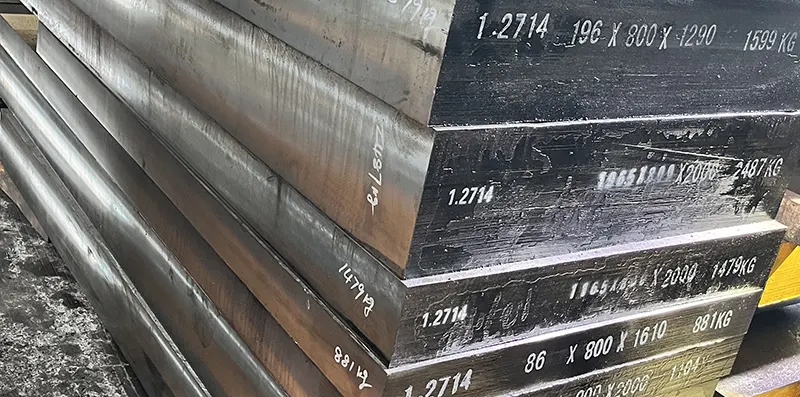
Common Mistakes When Buying 1.2714 Tool Steel

If you are purchasing 1.2714 steel from an international supplier, here are the most common mistakes you should avoid.


1. Buying Based on Price Alone

The lowest quotation is not necessarily the lowest-cost solution.

A 1.2714 forging block may look cheaper on the purchase order, but if it contains internal defects, has poor hardness uniformity, or requires excessive machining, the real cost can become much higher.

For a critical forging die, the total cost includes:

Cost Factor Possible Impact
Steel purchase price Initial investment
Machining CNC, milling, grinding
Heat treatment Hardening and tempering
Rework Additional machining
Die failure Replacement cost
Production downtime Lost production
Maintenance Repair and polishing

A slightly higher-quality steel block can be much cheaper over the entire service life of the die.

Don’t ask only, “Who offers the lowest price?” Ask, “Which supplier can provide the required quality consistently?”


2. Specifying Only “1.2714”

This is one of the most common purchasing mistakes.

A quotation request such as:

“Please quote 1.2714, 5 tons.”

does not provide enough technical information.

At minimum, you should specify:

  • Grade: 1.2714 / 55NiCrMoV6
  • Dimensions
  • Quantity
  • Supply condition
  • Hardness requirement
  • Ultrasonic testing requirement
  • Surface condition
  • Machining allowance
  • Delivery destination

For example, a much better specification could be:

1.2714 forged block, 500 × 600 × 1000 mm, quenched and tempered, 40–44 HRC, ultrasonic tested, EN 10204 3.1 MTC.

This reduces misunderstandings and makes supplier quotations easier to compare.


3. Assuming All 1.2714 Steel Has the Same Quality

Two suppliers can offer the same grade but deliver very different results.

Why?

Because steel quality depends on much more than chemical composition.

Important factors include:

  • Melting practice
  • Forging ratio
  • Homogenization
  • Heat treatment
  • Internal cleanliness
  • Inclusion control
  • Ultrasonic quality
  • Hardness uniformity

For a small round bar, internal quality may be less critical.

For a large 1.2714 forging block, however, internal soundness becomes extremely important.

The surface may look perfect while an internal defect remains hidden inside the block.

That’s why experienced buyers pay attention to the manufacturing route and inspection documentation, not just the material grade.


4. Ignoring the Size of the 1.2714 Block

Section size matters significantly in tool steel.

A 50 mm section does not behave like a 500 mm section during heat treatment.

The surface heats and cools differently from the center. If the block is very large, achieving a uniform structure and hardness throughout the section becomes more challenging.

Before ordering large 1.2714 blocks, confirm:

  • Maximum cross-section
  • Hardening method
  • Cooling method
  • Core hardness requirement
  • Surface-to-core hardness variation
  • Heat-treatment records

For critical large dies, hardness uniformity can be just as important as the nominal HRC value.

Buying 1.2714 tool steel is not simply a matter of finding the lowest price for a material with the correct grade number.

For demanding applications such as forging dies, hammer dies, press dies, die holders, and large tooling blocks, you need to consider the complete material specification.

The most common mistakes are buying based on price alone, ignoring section size, specifying only hardness, skipping UT testing, overlooking machining allowance, and assuming 1.2714 is automatically interchangeable with H13.

A good purchasing strategy is simple:

Define the application → identify the failure risk → specify the material condition → confirm hardness → specify internal quality → compare equivalent quotations.

At Dongguan Otai Special Steel, we can supply 1.2714 forged blocks and round bars according to your required dimensions, hardness, UT inspection, machining allowance, and certification requirements.

Email: rika@otaisteel.com
WhatsApp: +86 136 4282 5398

If you send us your 1.2714 size, quantity, required hardness, application, and destination, we can help you evaluate the specification before quotation.
0 0 Continue Reading →

What Hardness Can 1.2714 Achieve?

The achievable hardness of 1.2714 tool steel (55NiCrMoV6) depends mainly on the heat treatment process, section size, cooling method, and tempering temperature.

For most industrial applications, 1.2714 is not selected simply because it can reach a very high HRC value. Its real strength is the balance between hardness, toughness, and hardenability. This is particularly important for forging dies, die holders, hammer dies, and other heavy-duty hot-work tooling.

Typical Hardness Range of 1.2714

As a practical reference, 1.2714 can commonly be used at approximately 38–44 HRC after hardening and tempering.

Condition Typical Hardness Typical Purpose
Annealed Approx. 200–250 HB Machining before heat treatment
Hardened Can reach around 50+ HRC before tempering Intermediate heat-treatment condition
Hardened & tempered Approx. 38–44 HRC Forging dies and heavy-duty tooling
Lower tempered hardness Approx. 35–40 HRC Applications prioritizing toughness
Higher tempered hardness Approx. 42–46 HRC* Applications requiring more wear resistance

*The actual achievable value depends on the steel manufacturer’s specification, section size, heat-treatment parameters, and customer requirements.

What Hardness Should You Specify When Ordering 1.2714?

Instead of simply asking a supplier:

“Can 1.2714 reach 50 HRC?”

it is better to specify the required final working hardness based on the application.

For example:

1.2714, forged, quenched and tempered, 40–44 HRC, ultrasonic tested, EN 10204 3.1 MTC.

This gives the supplier much more useful information.

For a large forging die, you may also need to specify:

  • Dimension
  • Hardness range
  • UT standard
  • UT acceptance level
  • Heat-treatment condition
  • Machining allowance
  • MTC requirement


If you are sourcing 1.2714 tool steel, Dongguan Otai Special Steel can supply forged blocks, round bars, and customized sizes, with hardness, UT testing, machining allowance, and EN 10204 3.1 certification according to project requirements.

Email: rika@otaisteel.com
WhatsApp: +86 136 4282 5398

0 0 Continue Reading →

Why Is 1.2316 Different From Ordinary Mold Steel?

When choosing mold steel, many engineers and purchasing managers ask the same question:

“Why should I pay more for 1.2316 instead of using ordinary mold steel like P20 (1.2311) or 1.2738?”

The answer is simple: 1.2316 isn’t just another mold steel—it’s a corrosion-resistant stainless mold steel designed for demanding plastic molding applications. While ordinary mold steels perform well in general applications, they often struggle in humid environments, when processing corrosive plastics, or when high surface quality is required.

Let’s take a closer look at what makes 1.2316 stand out.


1. Superior Corrosion Resistance

The biggest difference between 1.2316 and ordinary mold steel is its corrosion resistance.

Most conventional mold steels contain only a small amount of chromium, making them susceptible to rust when exposed to:

  • Cooling water
  • Humid workshop environments
  • Long production shutdowns
  • PVC processing gases
  • Condensation

In contrast, 1.2316 contains approximately 15.5–17% chromium, which forms a protective passive layer on the surface. This significantly reduces the risk of corrosion and helps maintain mold performance over time.

Result: Longer mold life and lower maintenance costs.


2. Designed for Corrosive Plastic Materials

Not all plastics are mold-friendly.

Materials such as:

  • PVC
  • Flame-retardant plastics
  • Certain engineering plastics
  • Some recycled plastics

can release corrosive gases during molding. These gases gradually attack ordinary mold steels, causing rust, pitting, and surface deterioration.

1.2316 is specifically developed to withstand these harsh molding conditions, making it a preferred choice for processing corrosive polymers.


3. Better Surface Finish and Mirror Polishability

Many plastic products require a flawless appearance.

Examples include:

  • Cosmetic packaging
  • Medical components
  • Transparent containers
  • Optical lenses
  • Automotive interior trim

The mold surface directly determines the appearance of the finished plastic part.

1.2316 offers excellent polishability, allowing mold makers to achieve a high-gloss mirror finish with fewer polishing defects.

Compared with ordinary mold steel, it provides:

  • Better gloss
  • Improved transparency
  • Fewer polishing pits
  • More consistent surface quality

4. Longer Mold Service Life

Ordinary mold steels gradually lose performance due to:

  • Rust
  • Corrosion
  • Surface wear
  • Frequent polishing
  • Chemical attack

Each maintenance cycle removes a small amount of material, eventually shortening the mold’s useful life.

Because 1.2316 resists corrosion much more effectively, molds require less maintenance and remain in production longer.

For high-volume manufacturing, this translates into:

  • Lower downtime
  • Reduced repair costs
  • More consistent product quality
  • Higher production efficiency

5. Excellent Dimensional Stability

Large molds require stable materials.

Poor-quality steel may distort during machining or heat treatment, resulting in costly rework.

High-quality 1.2316 offers:

  • Uniform hardness
  • Stable internal structure
  • Excellent dimensional stability
  • Reliable machining performance

This is especially important for precision molds with tight tolerances.


6. Pre-Hardened for Faster Manufacturing

Most 1.2316 steel is supplied in a pre-hardened condition (typically 28–34 HRC).

Compared with soft annealed mold steel, this offers several advantages:

  • No additional hardening required for many applications
  • Shorter manufacturing lead time
  • Reduced heat treatment costs
  • Less risk of distortion after machining

Manufacturers can often machine the mold directly and move quickly into polishing and assembly.


7. Better Performance in Water-Cooling Systems

Most injection molds rely on internal cooling channels.

Unfortunately, water can cause corrosion inside these channels, especially if water quality is poor or maintenance is inadequate.

Ordinary mold steel may develop:

  • Rust deposits
  • Blocked cooling channels
  • Reduced cooling efficiency
  • Uneven mold temperatures

Because of its stainless characteristics, 1.2316 significantly reduces internal cooling channel corrosion, helping maintain stable production and consistent cycle times.


8. Lower Maintenance Costs

Although 1.2316 usually has a higher purchase price than conventional mold steel, its total cost of ownership is often lower.

Savings come from:

  • Less rust removal
  • Fewer polishing operations
  • Reduced repair frequency
  • Longer mold life
  • Lower production downtime

For molds with long production runs or high-value products, these savings can easily outweigh the initial material cost.


9. Comparison: 1.2316 vs. Ordinary Mold Steel

Property 1.2316 Mold Steel Ordinary Mold Steel (1.2311/P20)
Corrosion Resistance Excellent Moderate
Chromium Content 15.5–17% Around 2%
Rust Resistance Excellent Limited
Mirror Polishability Excellent Good
PVC Processing Highly Recommended Not Recommended for Long-Term Use
Cooling Channel Corrosion Very Low Higher Risk
Mold Maintenance Low Moderate to High
Mold Service Life Longer Shorter
Cost Higher Initial Cost Lower Initial Cost
Total Ownership Cost Lower Over Time Higher Due to Maintenance


Final Thoughts

The difference between 1.2316 and ordinary mold steel goes far beyond corrosion resistance. It is a premium stainless mold steel engineered to deliver longer service life, superior surface finish, excellent polishability, and lower maintenance costs.

While the initial investment may be higher, manufacturers often recover the extra cost through improved productivity, fewer repairs, and extended mold life.

If your application demands consistent quality, high production efficiency, and reliable long-term performance, 1.2316 is a smart investment rather than an additional expense.

0 Continue Reading →

1.2316 Large Plates – Premium Corrosion-Resistant Mold Steel for High-End Plastic Molds

What Is 1.2316 Steel?

1.2316 is a chromium-molybdenum stainless plastic mold steel developed specifically for molds operating in humid or corrosive environments.

Compared with ordinary mold steels such as 1.2311 (P20) or 1.2738, 1.2316 contains approximately 16% chromium, giving it significantly better corrosion resistance.

This steel is commonly supplied in the pre-hardened condition with hardness ranging from 28–34 HRC, allowing mold makers to machine it directly without additional heat treatment in many applications.

It is known under several international standards:

Standard Grade
DIN 1.2316
EN X36CrMo17
AISI Equivalent Modified 420 Stainless Mold Steel
JIS Similar SUS420J2 (Not identical)

Why Are Large 1.2316 Plates Becoming More Popular?

Many modern plastic products are becoming larger and more sophisticated.

Examples include:

  • Automotive bumpers
  • Home appliance housings
  • Medical equipment shells
  • Refrigerator liners
  • Large storage containers
  • Cosmetic mold bases
  • Food packaging molds
  • Optical products

These molds require:

  • Larger mold blocks
  • Better dimensional stability
  • Uniform hardness
  • Excellent polishing performance
  • Long service life

Large 1.2316 plates satisfy all these requirements.

Instead of welding smaller blocks together, manufacturers can machine one solid plate, improving mold strength while reducing production risk.


Chemical Composition of 1.2316 Steel

The excellent corrosion resistance of 1.2316 comes from its carefully balanced alloy composition.

Element Content (%)
Carbon (C) 0.33–0.45
Silicon (Si) ≤1.00
Manganese (Mn) ≤1.00
Chromium (Cr) 15.5–17.0
Molybdenum (Mo) 0.80–1.30
Phosphorus (P) ≤0.030
Sulfur (S) ≤0.030

Why does chromium matter?

Chromium forms a passive oxide layer on the steel surface, protecting it from rust and corrosion.

With over 15% chromium, 1.2316 performs much better than standard mold steels when exposed to:

  • Humidity
  • Cooling water
  • PVC processing gases
  • Acidic environments
  • Condensation


Available Dimensions from Dongguan Otai Special Steel

We supply 1.2316 large plates in a wide range of sizes.

Typical supply includes:

Thickness Width Length
20–80 mm Up to 1500 mm Up to 6000 mm
80–300 mm Up to 2200 mm Up to 6000 mm
300–800 mm Custom Custom

Custom cutting is also available according to customer drawings.


Quality Inspection Before Delivery

Every 1.2316 large plate undergoes strict inspection before shipment.

Our inspection includes:

  • Chemical composition analysis
  • Hardness testing
  • Ultrasonic testing (UT)
  • Surface inspection
  • Dimensional inspection
  • Material traceability
  • EN 10204 3.1 Material Test Certificate (MTC)

Additional testing is available upon request, including third-party inspections.


Why Choose Dongguan Otai Special Steel?

With years of experience exporting special steel worldwide, Dongguan Otai Special Steel has become a trusted supplier for mold manufacturers in Europe, Southeast Asia, the Middle East, South America, and beyond.

We offer:

  • Premium-quality 1.2316 large plates
  • Competitive factory pricing
  • Fast international delivery
  • Custom cutting services
  • Professional export packing
  • Experienced technical support
  • Flexible order quantities
  • Full inspection reports and certifications

Whether you need a single mold block or bulk quantities for production, we can provide reliable solutions tailored to your project.

Contact us today for a fast quotation:

📧 Email: rika@otaisteel.com

📱 WhatsApp: +86 136 4282 5398

0 Continue Reading →

How to Buy 4140 Steel: A Complete Purchasing Guide

Choosing the correct steel grade is only the first step. Selecting the right supplier, delivery condition, size, testing requirements, and quality standard is equally important.

Many buyers focus only on the material price when purchasing 4140 steel round bars or forged blocks. However, the cheapest material is not always the most economical choice.

A small difference in steel quality can lead to:

  • Higher machining costs
  • Shorter service life
  • Unexpected cracking during heat treatment
  • Production delays
  • Increased maintenance expenses

Therefore, understanding how to purchase 4140 steel correctly can help you avoid unnecessary problems and achieve better long-term value.


4140 Steel Size Availability

4140 steel is available in a wide range of sizes.

Typical round bar sizes:

Diameter Range Common Usage
10–50 mm Small mechanical parts
50–150 mm Shafts, gears, machine components
150–300 mm Heavy machinery parts
Above 300 mm Large forgings

However, availability depends on the supplier’s production capability and stock situation.

For large diameter 4140 steel, forged production is usually recommended because forging improves internal quality and mechanical properties.


4140 Steel Quality Inspection: What Should Buyers Check?

When purchasing alloy steel from overseas suppliers, quality inspection is extremely important.

A professional steel supplier should be able to provide complete quality documentation.

Important inspection items include:


Chemical Composition Test

Chemical analysis confirms that the steel meets the required specification.

Typical testing methods:

  • Optical Emission Spectrometer (OES)
  • PMI testing

The test verifies:

  • Carbon content
  • Chromium content
  • Molybdenum content
  • Other alloy elements

Ultrasonic Testing (UT)

For high-quality 4140 steel, ultrasonic testing is often required.

UT inspection detects internal defects such as:

  • Cracks
  • Shrinkage
  • Inclusions
  • Internal voids

This is especially important for:

  • Large diameter bars
  • Forged blocks
  • Critical mechanical components

Mechanical Property Testing

A reliable supplier should provide mechanical test results including:

  • Tensile strength
  • Yield strength
  • Elongation
  • Hardness

These values confirm whether the material can perform under real working conditions.


Third-Party Inspection

For important projects, customers may request inspection from independent organizations.

Common inspection companies include:

  • SGS
  • Bureau Veritas
  • Intertek

Third-party inspection provides additional confidence, especially for international purchasing.


4140 Steel Certification Requirements

Different markets may require different documentation.

Common certificates include:

EN10204 3.1 Material Certificate

This is one of the most widely requested documents worldwide.

It normally includes:

  • Heat number
  • Chemical analysis
  • Mechanical properties
  • Steel grade
  • Delivery condition


ISO Quality System

Many professional steel suppliers operate under:

  • ISO 9001 Quality Management System

This ensures consistent production control.


Factors Affecting 4140 Steel Price

Many customers ask:

“Why are quotations from different suppliers sometimes very different?”

The price of 4140 steel depends on several factors.

Factor Influence
Raw Material Cost Major impact
Diameter & Size Larger sizes cost more
Production Method Forged material costs higher
Heat Treatment Adds processing cost
Testing Requirements Extra inspection increases cost
Quantity Larger orders reduce unit cost
Surface Condition Precision surfaces increase price

A lower price does not always mean a better deal.

The real value comes from balancing:

Material quality + Delivery reliability + Technical support + Total production cost


Why Choose Dongguan Otai Special Steel for 4140 Steel Supply?

At Dongguan Otai Special Steel, we understand that customers are not only buying steel—they are buying reliability.

For international customers, we provide:

✔ High-quality 4140 / 42CrMo / 42CrMo4 alloy steel

✔ Round bars, flat bars, and forged blocks

✔ Customized cutting service

✔ Ultrasonic testing according to customer requirements

✔ EN10204 3.1 material certificates

✔ Export packaging suitable for international shipment

✔ Technical support for material selection

Our goal is simple:

To help customers choose the right steel, reduce production risks, and achieve better long-term performance.

If you are looking for reliable 4140 steel suppliers, 4140 round bars, or 42CrMo4 equivalent materials, feel free to contact us.

Email: rika@otaisteel.com

WhatsApp: +8613642825398


0 Continue Reading →

Common Applications of 4140 Steel

One of the biggest reasons for the worldwide popularity of 4140 alloy steel is its versatility.

Instead of being limited to one industry, 4140 steel is used across dozens of sectors because it combines high strength, excellent toughness, good fatigue resistance, and reasonable cost.

Whether you are manufacturing heavy equipment or precision machinery, there is a good chance that 4140 steel can meet your requirements.

Let’s look at the industries where this material truly shines.


4140 Steel for Oil & Gas Equipment

The oil and gas industry operates in one of the harshest environments imaginable.

Components must withstand:

  • High pressure
  • Heavy loads
  • Continuous vibration
  • Abrasive wear
  • Shock loading

Because of these demanding conditions, 4140 steel is commonly used for:

  • Drill collars
  • Drill subs
  • Tool joints
  • Valve bodies
  • Pump shafts
  • Couplings
  • Flanges

Its excellent fatigue strength helps reduce the risk of unexpected failures during long-term service.


4140 Steel in Mining Machinery

Mining equipment experiences constant impact from rocks, dust, and heavy loads.

4140 steel is widely used for manufacturing:

  • Crusher shafts
  • Drive shafts
  • Gear blanks
  • Hydraulic cylinders
  • Pin shafts
  • Excavator pins
  • Bucket linkage components

Compared with ordinary carbon steel, properly heat-treated 4140 provides significantly longer service life.


4140 Steel for Automotive Components

The automotive industry has relied on 4140 steel for decades.

Typical applications include:

  • Crankshafts
  • Axles
  • Steering components
  • Drive shafts
  • Differential gears
  • Suspension parts
  • Wheel hubs

These components require a careful balance between strength and toughness.

A material that is too soft wears quickly.

A material that is too hard may crack under repeated loading.

4140 steel strikes the perfect balance.


4140 Steel in Agricultural Machinery

Agricultural equipment often operates under harsh outdoor conditions.

Dust, mud, heavy loads, and repeated impacts place enormous stress on machinery.

4140 steel is commonly used for:

  • Tractor shafts
  • Gear components
  • Hydraulic rods
  • PTO shafts
  • Bearing seats

Farm equipment manufacturers appreciate its durability and relatively low maintenance requirements.


4140 Steel for Plastic Machinery

Many people associate 4140 with mechanical engineering, but it also plays an important role in plastic processing equipment.

Typical applications include:

  • Extrusion screws
  • Barrel supports
  • Mold bases
  • Clamping systems
  • Guide pillars

After nitriding, 4140 develops excellent surface hardness while maintaining a tough core, making it ideal for long production cycles.


4140 Steel in Construction Equipment

Construction machinery operates in challenging environments where reliability is essential.

4140 steel is widely used for:

  • Crane pins
  • Boom joints
  • Hydraulic pistons
  • Roller shafts
  • Connecting rods
  • Pivot pins

These components are constantly subjected to cyclic loading, making fatigue resistance a critical requirement.


4140 Steel vs 1045 Steel

This is one of the most frequently searched comparisons online.

Property 4140 Steel 1045 Steel
Carbon Content Medium Alloy Medium Carbon
Strength Excellent Good
Toughness Excellent Moderate
Hardenability Excellent Limited
Wear Resistance High Moderate
Machinability Good Excellent
Cost Higher Lower

When Should You Choose 1045?

1045 is suitable for:

  • General shafts
  • Low-load components
  • Budget-sensitive projects
  • Easy machining

When Should You Choose 4140?

Choose 4140 if your parts require:

  • Higher strength
  • Better fatigue resistance
  • Better impact resistance
  • Longer service life

4140 Steel vs 4340 Steel

Many customers ask whether 4340 is always better.

The answer is not necessarily.

Property 4140 4340
Strength High Very High
Toughness High Excellent
Fatigue Resistance Excellent Superior
Cost Lower Higher
Machinability Better Slightly Lower

4340 contains additional nickel, which greatly improves toughness.

However, if your application does not require extreme impact resistance, 4140 often provides the better value.


4140 Steel vs 4130 Steel

Although both belong to the chromium-molybdenum family, they are designed for different purposes.

Property 4130 4140
Carbon Lower Higher
Strength Moderate Higher
Toughness Good Better
Weldability Excellent Moderate
Heat Treatment Response Good Excellent

4130 is commonly used in aircraft tubing and racing chassis.

4140 is preferred for heavily loaded mechanical components.


4140 Steel vs 42CrMo4

This question is especially common among European buyers.

The good news is that these grades are almost equivalent.

AISI DIN EN
4140 42CrMo4 42CrMo4

Minor differences exist in chemical composition tolerances and testing standards, but in most industrial applications they can replace each other after confirming customer specifications.


Why Engineers Around the World Continue to Choose 4140 Steel

Engineering is always about finding the right balance.

Some steels are stronger.

Some are cheaper.

Some resist corrosion better.

But very few materials combine strength, toughness, machinability, availability, and affordability as successfully as 4140 alloy steel.

That is why it remains one of the most trusted engineering materials in industries ranging from automotive manufacturing to heavy mining equipment.

0 Continue Reading →

4140 Steel Heat Treatment: Unlocking Its Full Performance

One of the biggest reasons engineers choose 4140 alloy steel is its outstanding response to heat treatment. Unlike ordinary carbon steels, 4140 can achieve a wide range of mechanical properties simply by adjusting the heat treatment process.

Think of heat treatment as tuning a high-performance engine. The raw material already has great potential, but the right treatment allows you to optimize it for strength, toughness, wear resistance, or machinability depending on your application.

For this reason, understanding heat treatment is essential before selecting 4140 steel for your project.


Annealing 4140 Steel

Annealing is commonly performed before machining large components.

The main purpose is to soften the steel, relieve internal stress, and improve machinability.

Typical Annealing Process

Process Temperature
Heating 830–870°C
Holding Time 1 hour per 25 mm thickness
Cooling Furnace cooling

After annealing, the hardness usually drops to approximately 197–230 HB, making drilling, turning, milling, and boring much easier.

This condition is especially recommended for manufacturers producing complex precision components.


Normalizing 4140 Steel

Normalizing refines the grain structure and improves mechanical consistency.

Compared with annealing, normalized steel provides:

  • Better strength
  • Better toughness
  • More uniform microstructure
  • Reduced internal stress

Typical Normalizing Parameters

Process Temperature
Heating 870–900°C
Cooling Air cooling

Many forging factories normalize 4140 forgings before further machining or heat treatment.


Hardening (Quenching) of 4140 Steel

Hardening is where 4140 truly demonstrates its value.

The steel is heated above the austenitizing temperature and then rapidly cooled to form martensite.

Typical Hardening Process

Process Temperature
Preheating 650–700°C
Austenitizing 840–870°C
Quenching Medium Oil

Oil quenching is generally preferred because it minimizes distortion while achieving excellent hardness.

For large-diameter bars, professional heat treatment control is especially important to ensure uniform hardness from the surface to the core.


Tempering 4140 Steel

Freshly quenched 4140 steel is extremely hard but also relatively brittle.

Tempering solves this problem by restoring toughness while maintaining high strength.

The final mechanical properties depend largely on the tempering temperature.

Tempering Temperature Typical Hardness
200°C 54 HRC
300°C 50 HRC
400°C 45 HRC
500°C 38 HRC
600°C 30 HRC

Lower tempering temperatures produce higher hardness.

Higher tempering temperatures improve impact toughness and fatigue resistance.

Selecting the correct tempering temperature depends entirely on the working conditions of the finished component.


Stress Relieving

Large machined components often contain residual machining stress.

Stress relieving helps prevent distortion during finish machining.

Typical parameters:

  • Temperature: 550–650°C
  • Cooling: Furnace cooling

This treatment is especially recommended for:

  • Large shafts
  • Forged blocks
  • Hydraulic cylinders
  • Heavy machinery parts

4140 Steel Hardness Explained

One of the questions buyers ask most frequently is:

“How hard is 4140 steel?”

The answer depends entirely on its delivery condition.

Supply Condition Hardness
Annealed 197–230 HB
Normalized 220–260 HB
Pre-Hardened 28–32 HRC
Quenched & Tempered 32–55 HRC
Induction Hardened Surface 55–60 HRC
Nitrided Surface Up to 65 HRC

This flexibility is one of the biggest reasons why 4140 is suitable for such a wide range of industries.


Can 4140 Steel Be Surface Hardened?

Absolutely.

Although 4140 already provides excellent through-hardening capability, many manufacturers further improve surface performance through additional hardening processes.

The most common methods include:

Induction Hardening

Induction hardening rapidly heats only the surface layer.

Advantages include:

  • High surface hardness
  • Excellent wear resistance
  • Tough core remains unchanged
  • Short processing time

Typical surface hardness:

55–60 HRC


Nitriding

Nitriding introduces nitrogen into the steel surface.

Compared with induction hardening, nitriding provides:

  • Higher surface hardness
  • Better wear resistance
  • Excellent fatigue strength
  • Outstanding corrosion resistance improvement
  • Minimal distortion

Typical nitrided hardness:

60–65 HRC

This makes nitrided 4140 ideal for:

  • Hydraulic rods
  • Gear shafts
  • Extrusion screws
  • Plastic machinery
  • Automotive transmission components

Why Heat Treatment Makes 4140 So Versatile

What makes 4140 stand out is not just its chemical composition—it is the remarkable flexibility offered by heat treatment.

The same steel grade can be tailored for vastly different applications:

  • Need excellent machinability? Choose the annealed condition.
  • Need a balance of strength and toughness? Select quenched and tempered 28–32 HRC.
  • Need exceptional wear resistance? Apply induction hardening or nitriding.
  • Need superior fatigue performance? Optimize the tempering process.

This adaptability allows engineers to use one steel grade across a wide range of industries while meeting different performance requirements.

0 Continue Reading →

What Is 4140 Steel? Everything You Need to Know

What Is 4140 Steel?

If you work in the machinery, automotive, oil & gas, mining, or heavy equipment industry, you’ve probably heard about 4140 steel. It is one of the most widely used low-alloy steels in the world because it offers an excellent balance of strength, toughness, wear resistance, and machinability.

But what exactly is 4140 steel? Why do engineers, machine shops, and steel distributors prefer it over many other alloy steels? Is it suitable for your project?

In this complete guide, we’ll answer all of these questions and much more.

Whether you’re purchasing round bars, forged blocks, flat bars, or pre-machined materials, understanding the characteristics of 4140 steel can help you reduce manufacturing costs, improve product performance, and extend service life.


What Does “4140” Mean?

Many buyers assume that “4140” is simply a product name. In fact, it is a steel designation defined by the AISI/SAE steel classification system.

The number “4140” provides useful information about the alloy.

  • The first two digits (41) indicate that it belongs to the chromium-molybdenum alloy steel family.
  • The last two digits (40) represent the approximate carbon content of 0.40%.

This combination of chromium, molybdenum, and carbon gives the steel its excellent hardenability and mechanical performance.

Compared with plain carbon steels such as 1045, 4140 offers significantly better strength after heat treatment while maintaining good toughness.


International Equivalent Grades of 4140 Steel

One interesting fact is that engineers around the world often use different names for essentially the same material.

Country Standard Equivalent Grade
USA ASTM / AISI 4140
Germany DIN 42CrMo4
Europe EN 42CrMo4
Japan JIS SCM440
China GB 42CrMo
France AFNOR 42CD4
United Kingdom BS 708M40
ISO ISO 42CrMo4

Although these grades have slightly different specification ranges, their chemical composition and mechanical properties are very similar.

This is why a European customer may request 42CrMo4, while a Japanese customer asks for SCM440, and an American buyer specifies AISI 4140.

In most engineering applications, these materials are interchangeable after confirming the standard requirements.


4140 Steel Chemical Composition

The excellent performance of 4140 steel comes from its carefully balanced alloy composition.

Element Typical Content (%)
Carbon (C) 0.38–0.43
Silicon (Si) 0.15–0.35
Manganese (Mn) 0.75–1.00
Chromium (Cr) 0.80–1.10
Molybdenum (Mo) 0.15–0.25
Phosphorus (P) ≤0.035
Sulfur (S) ≤0.040

Each alloying element has an important role.

Carbon

Carbon determines the steel’s hardness and strength after heat treatment.

Higher carbon generally means higher hardness but lower weldability.

Chromium

Chromium improves:

  • Hardenability
  • Wear resistance
  • Oxidation resistance
  • Fatigue strength

However, 4140 does not contain enough chromium to be considered stainless steel.

Molybdenum

Molybdenum increases:

  • High-temperature strength
  • Temper resistance
  • Deep hardening capability
  • Toughness

This is one of the reasons why 4140 performs much better than plain carbon steels.

Manganese

Manganese contributes to:

  • Higher tensile strength
  • Better hardenability
  • Improved machinability

Silicon

Silicon increases elasticity and improves deoxidation during steelmaking.


Key Mechanical Properties of 4140 Steel

One reason 4140 remains so popular is that it offers an outstanding combination of strength and toughness.

Typical mechanical properties after quenching and tempering are shown below.

Property Typical Value
Tensile Strength 850–1100 MPa
Yield Strength 655–950 MPa
Elongation 15–25%
Impact Toughness Excellent
Hardness 28–32 HRC (Pre-hardened)
Density 7.85 g/cm³
Elastic Modulus 205 GPa

These values may vary depending on heat treatment conditions and section size.

Compared with standard carbon steel, 4140 maintains high strength while offering better fatigue resistance and impact performance.

This is why it is widely used for highly stressed components.


Why Is 4140 Steel So Popular?

Imagine choosing a steel material like choosing a vehicle.

  • 1045 steel is like a reliable family sedan—economical and easy to use.
  • Stainless steel is like an SUV—it resists harsh weather but costs more.
  • 4340 steel is like a luxury sports car—extremely strong but more expensive.

4140 steel sits right in the middle.

It delivers an excellent balance of performance, availability, and cost, making it one of the best value-for-money engineering steels on the market.

That is why manufacturers across industries—from agricultural machinery to mining equipment—continue to rely on 4140 steel year after year.

0 Continue Reading →

Why 1.2083 Stainless Mold Steel Causes Pit Holes After Machining | Cleanliness & Steelmaking Process Explained

If you are working with 1.2083 stainless mold steel (X42Cr13 / AISI 420 modified), you may have experienced a frustrating issue:

After CNC machining, grinding, or mirror polishing, small defects like pit holes, black dots, or surface pores suddenly appear.

This problem is extremely common in high-polish plastic mold applications, especially in:

  • Transparent plastic molds
  • Optical lens molds
  • Medical device molds
  • Cosmetic packaging molds
  • High-gloss injection molds

But here is the real truth most suppliers do not explain:

Pit holes are not machining defects — they are hidden metallurgical defects revealed after machining.

What Are Pit Holes in 1.2083 Steel?

Pit holes (surface pitting defects) refer to:

Small cavities, micro-holes, or black dots appearing after machining or polishing.

They are usually visible as:

  • Tiny dark spots
  • Micro pores
  • Surface “sand holes”
  • Local surface collapse

These defects are not created during machining.

Instead, machining simply exposes what already exists inside the steel.


Why Do Pit Holes Only Appear After Machining or Polishing?

This is one of the most misunderstood issues in mold steel.

Before machining:

  • Defects are hidden under raw surface layer
  • Oxide scale or allowance covers internal structure

After machining:

  • Surface layer is removed
  • Internal inclusions become exposed
  • Microvoids open up → pit holes appear

👉 In short:

Machining does not create the problem — it reveals the problem.

How to Prevent Pit Holes in 1.2083 Steel

1. Choose ESR-Grade Steel (Most Important)

ESR refining removes:

  • Non-metallic inclusions
  • Gas bubbles
  • Segregation defects

👉 This is the #1 solution for mirror molds.


2. Require Low Sulfur Specification

Recommended:

  • S ≤ 0.003% for high-end molds

Lower sulfur = fewer MnS inclusions.


3. Ensure VD Vacuum Degassing

This reduces:

  • Hydrogen porosity
  • Oxygen content
  • Nitrogen defects

4. Control Heat Treatment Quality

Improper heat treatment can increase:

  • Internal stress
  • Micro-cracks
  • Surface instability

5. Use Proper Polishing Sequence

Incorrect polishing causes defect amplification:

  • Too aggressive grinding
  • Skipping grit steps
  • Uneven pressure

Conclusion

Pit holes in 1.2083 stainless mold steel are not caused by machining mistakes. They are the direct result of:

  • Steel cleanliness level
  • Steelmaking process quality
  • Inclusion control
  • ESR refinement level
  • Sulfur and oxygen content

If you want mirror-quality mold surfaces, the key is not just choosing 1.2083 steel—but choosing the right production grade of 1.2083.

👉 For high-end mold applications, always prioritize:

  • ESR 1.2083
  • Low sulfur steel
  • Vacuum-degassed material
  • Stable steelmaking process

Because in precision molds:

Steel cleanliness determines final surface perfection.

For technical support or premium 1.2083 ESR mold steel supply, you can contact Dongguan Otai Special Steel for professional selection advice and quotations.

📧 Email: rika@otaisteel.com
📱 WhatsApp: +86 136 4282 5398

0 Continue Reading →

S355JR vs S355J2: Same Steel, But Not the Same Performance

What is S355 Structural Steel?

S355 is a non-alloy structural steel grade widely used in Europe and global engineering markets.

The naming is simple:

  • S = Structural steel
  • 355 = Minimum yield strength (355 MPa)

What makes S355 so popular is its excellent balance between strength, weldability, and cost efficiency.

But S355 is not a single material—it has different sub-grades, and that’s where JR and J2 come in.


What Do JR and J2 Mean?

This is the most important part of the comparison.

The suffix defines impact toughness testing temperature.

  • S355JR → Impact tested at +20°C
  • S355J2 → Impact tested at -20°C

This is not a small detail. It directly affects how the steel behaves in cold environments.

Think of it like tires:

  • JR = normal all-season tire
  • J2 = winter tire designed for cold conditions

Same vehicle, but completely different safety performance in harsh environments.


Chemical Composition Comparison

Although they are similar, S355J2 has tighter impurity control.

Element S355JR S355J2
Carbon (C) ≤ 0.24% ≤ 0.22%
Manganese (Mn) ≤ 1.60% ≤ 1.60%
Phosphorus (P) ≤ 0.045% ≤ 0.035%
Sulfur (S) ≤ 0.045% ≤ 0.035%

The key difference is not carbon—it is lower impurity levels in S355J2, which improves toughness and reduces brittle fracture risk.


Mechanical Properties: Almost Identical Strength

Property S355JR S355J2
Yield Strength ≥ 355 MPa ≥ 355 MPa
Tensile Strength 470–630 MPa 470–630 MPa
Elongation ~22% ~22%
Impact Test Temperature +20°C -20°C

From a strength perspective, they are the same.

So why is S355J2 more expensive and more widely used in critical structures?

The answer is toughness at low temperature.


Common Misunderstanding in the Market

Many buyers make this mistake:

“Same strength = same material”

This is incorrect.

Strength only tells you how much load it can hold.

Toughness tells you how it fails when conditions become extreme.

And in engineering, failure behavior is often more important than strength.


Conclusion

S355JR and S355J2 may look similar in chemical composition and strength, but their real-world performance is not the same.

The key difference is not strength—it is impact toughness at low temperature.

  • If your project is in a normal environment, S355JR is cost-effective and reliable
  • If your project faces cold weather or safety-critical conditions, S355J2 is the safer and more professional choice

In steel selection, the right material is not the strongest or the cheapest—it is the one that performs correctly in your real working environment.

For professional supply of S355JR and S355J2 steel plates, bars, and structural materials, Dongguan Otai Special Steel provides stable quality and technical support.

📧 Email: rika@otaisteel.com
📱 WhatsApp: +86 136 4282 5398

0 Continue Reading →


Recent Comments by Rika

    No comments by Rika