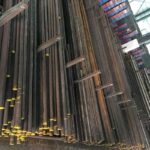
One of the biggest reasons for the worldwide popularity of 4140 alloy steel is its versatility.
Instead of being limited to one industry, 4140 steel is used across dozens of sectors because it combines high strength, excellent toughness, good fatigue resistance, and reasonable cost.
Whether you are manufacturing heavy equipment or precision machinery, there is a good chance that 4140 steel can meet your requirements.
Let’s look at the industries where this material truly shines.
4140 Steel for Oil & Gas Equipment
The oil and gas industry operates in one of the harshest environments imaginable.
Components must withstand:
- High pressure
- Heavy loads
- Continuous vibration
- Abrasive wear
- Shock loading
Because of these demanding conditions, 4140 steel is commonly used for:
- Drill collars
- Drill subs
- Tool joints
- Valve bodies
- Pump shafts
- Couplings
- Flanges
Its excellent fatigue strength helps reduce the risk of unexpected failures during long-term service.
4140 Steel in Mining Machinery
Mining equipment experiences constant impact from rocks, dust, and heavy loads.
4140 steel is widely used for manufacturing:
- Crusher shafts
- Drive shafts
- Gear blanks
- Hydraulic cylinders
- Pin shafts
- Excavator pins
- Bucket linkage components
Compared with ordinary carbon steel, properly heat-treated 4140 provides significantly longer service life.
4140 Steel for Automotive Components
The automotive industry has relied on 4140 steel for decades.
Typical applications include:
- Crankshafts
- Axles
- Steering components
- Drive shafts
- Differential gears
- Suspension parts
- Wheel hubs
These components require a careful balance between strength and toughness.
A material that is too soft wears quickly.
A material that is too hard may crack under repeated loading.
4140 steel strikes the perfect balance.
4140 Steel in Agricultural Machinery
Agricultural equipment often operates under harsh outdoor conditions.
Dust, mud, heavy loads, and repeated impacts place enormous stress on machinery.
4140 steel is commonly used for:
- Tractor shafts
- Gear components
- Hydraulic rods
- PTO shafts
- Bearing seats
Farm equipment manufacturers appreciate its durability and relatively low maintenance requirements.
4140 Steel for Plastic Machinery
Many people associate 4140 with mechanical engineering, but it also plays an important role in plastic processing equipment.
Typical applications include:
- Extrusion screws
- Barrel supports
- Mold bases
- Clamping systems
- Guide pillars
After nitriding, 4140 develops excellent surface hardness while maintaining a tough core, making it ideal for long production cycles.
4140 Steel in Construction Equipment
Construction machinery operates in challenging environments where reliability is essential.
4140 steel is widely used for:
- Crane pins
- Boom joints
- Hydraulic pistons
- Roller shafts
- Connecting rods
- Pivot pins
These components are constantly subjected to cyclic loading, making fatigue resistance a critical requirement.
4140 Steel vs 1045 Steel
This is one of the most frequently searched comparisons online.
| Property | 4140 Steel | 1045 Steel |
|---|---|---|
| Carbon Content | Medium Alloy | Medium Carbon |
| Strength | Excellent | Good |
| Toughness | Excellent | Moderate |
| Hardenability | Excellent | Limited |
| Wear Resistance | High | Moderate |
| Machinability | Good | Excellent |
| Cost | Higher | Lower |
When Should You Choose 1045?
1045 is suitable for:
- General shafts
- Low-load components
- Budget-sensitive projects
- Easy machining
When Should You Choose 4140?
Choose 4140 if your parts require:
- Higher strength
- Better fatigue resistance
- Better impact resistance
- Longer service life
4140 Steel vs 4340 Steel
Many customers ask whether 4340 is always better.
The answer is not necessarily.
| Property | 4140 | 4340 |
|---|---|---|
| Strength | High | Very High |
| Toughness | High | Excellent |
| Fatigue Resistance | Excellent | Superior |
| Cost | Lower | Higher |
| Machinability | Better | Slightly Lower |
4340 contains additional nickel, which greatly improves toughness.
However, if your application does not require extreme impact resistance, 4140 often provides the better value.
4140 Steel vs 4130 Steel
Although both belong to the chromium-molybdenum family, they are designed for different purposes.
| Property | 4130 | 4140 |
|---|---|---|
| Carbon | Lower | Higher |
| Strength | Moderate | Higher |
| Toughness | Good | Better |
| Weldability | Excellent | Moderate |
| Heat Treatment Response | Good | Excellent |
4130 is commonly used in aircraft tubing and racing chassis.
4140 is preferred for heavily loaded mechanical components.
4140 Steel vs 42CrMo4
This question is especially common among European buyers.
The good news is that these grades are almost equivalent.
| AISI | DIN | EN |
|---|---|---|
| 4140 | 42CrMo4 | 42CrMo4 |
Minor differences exist in chemical composition tolerances and testing standards, but in most industrial applications they can replace each other after confirming customer specifications.
Why Engineers Around the World Continue to Choose 4140 Steel
Engineering is always about finding the right balance.
Some steels are stronger.
Some are cheaper.
Some resist corrosion better.
But very few materials combine strength, toughness, machinability, availability, and affordability as successfully as 4140 alloy steel.
That is why it remains one of the most trusted engineering materials in industries ranging from automotive manufacturing to heavy mining equipment.