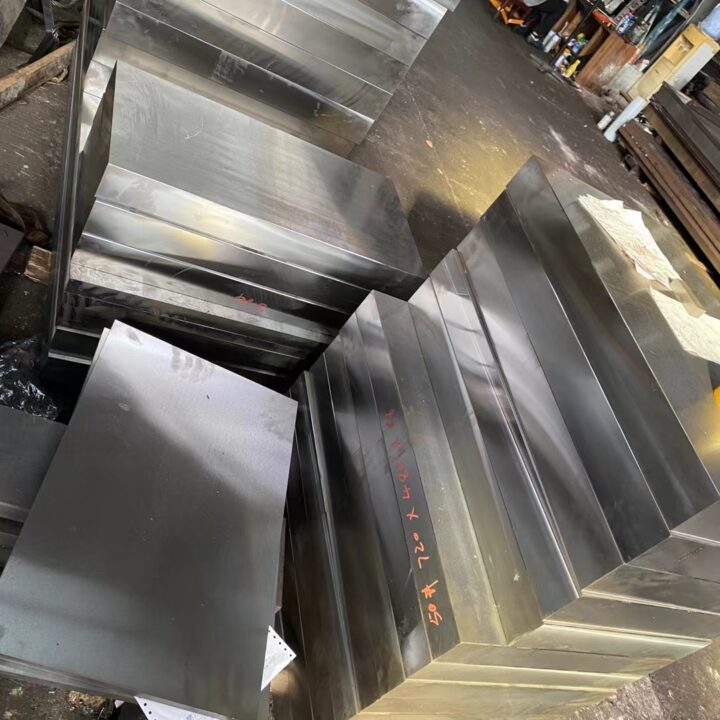
If you are purchasing 1.2714 steel from an international supplier, here are the most common mistakes you should avoid.
1. Buying Based on Price Alone
The lowest quotation is not necessarily the lowest-cost solution.
A 1.2714 forging block may look cheaper on the purchase order, but if it contains internal defects, has poor hardness uniformity, or requires excessive machining, the real cost can become much higher.
For a critical forging die, the total cost includes:
| Cost Factor | Possible Impact |
|---|---|
| Steel purchase price | Initial investment |
| Machining | CNC, milling, grinding |
| Heat treatment | Hardening and tempering |
| Rework | Additional machining |
| Die failure | Replacement cost |
| Production downtime | Lost production |
| Maintenance | Repair and polishing |
A slightly higher-quality steel block can be much cheaper over the entire service life of the die.
Don’t ask only, “Who offers the lowest price?” Ask, “Which supplier can provide the required quality consistently?”
2. Specifying Only “1.2714”
This is one of the most common purchasing mistakes.
A quotation request such as:
“Please quote 1.2714, 5 tons.”
does not provide enough technical information.
At minimum, you should specify:
- Grade: 1.2714 / 55NiCrMoV6
- Dimensions
- Quantity
- Supply condition
- Hardness requirement
- Ultrasonic testing requirement
- Surface condition
- Machining allowance
- Delivery destination
For example, a much better specification could be:
1.2714 forged block, 500 × 600 × 1000 mm, quenched and tempered, 40–44 HRC, ultrasonic tested, EN 10204 3.1 MTC.
This reduces misunderstandings and makes supplier quotations easier to compare.
3. Assuming All 1.2714 Steel Has the Same Quality
Two suppliers can offer the same grade but deliver very different results.
Why?
Because steel quality depends on much more than chemical composition.
Important factors include:
- Melting practice
- Forging ratio
- Homogenization
- Heat treatment
- Internal cleanliness
- Inclusion control
- Ultrasonic quality
- Hardness uniformity
For a small round bar, internal quality may be less critical.
For a large 1.2714 forging block, however, internal soundness becomes extremely important.
The surface may look perfect while an internal defect remains hidden inside the block.
That’s why experienced buyers pay attention to the manufacturing route and inspection documentation, not just the material grade.
4. Ignoring the Size of the 1.2714 Block
Section size matters significantly in tool steel.
A 50 mm section does not behave like a 500 mm section during heat treatment.
The surface heats and cools differently from the center. If the block is very large, achieving a uniform structure and hardness throughout the section becomes more challenging.
Before ordering large 1.2714 blocks, confirm:
- Maximum cross-section
- Hardening method
- Cooling method
- Core hardness requirement
- Surface-to-core hardness variation
- Heat-treatment records
For critical large dies, hardness uniformity can be just as important as the nominal HRC value.
Buying 1.2714 tool steel is not simply a matter of finding the lowest price for a material with the correct grade number.
For demanding applications such as forging dies, hammer dies, press dies, die holders, and large tooling blocks, you need to consider the complete material specification.
The most common mistakes are buying based on price alone, ignoring section size, specifying only hardness, skipping UT testing, overlooking machining allowance, and assuming 1.2714 is automatically interchangeable with H13.
A good purchasing strategy is simple:
Define the application → identify the failure risk → specify the material condition → confirm hardness → specify internal quality → compare equivalent quotations.
At Dongguan Otai Special Steel, we can supply 1.2714 forged blocks and round bars according to your required dimensions, hardness, UT inspection, machining allowance, and certification requirements.
Email: rika@otaisteel.com
WhatsApp: +86 136 4282 5398
If you send us your 1.2714 size, quantity, required hardness, application, and destination, we can help you evaluate the specification before quotation.