One of the biggest reasons engineers choose 4140 alloy steel is its outstanding response to heat treatment. Unlike ordinary carbon steels, 4140 can achieve a wide range of mechanical properties simply by adjusting the heat treatment process.
Think of heat treatment as tuning a high-performance engine. The raw material already has great potential, but the right treatment allows you to optimize it for strength, toughness, wear resistance, or machinability depending on your application.
For this reason, understanding heat treatment is essential before selecting 4140 steel for your project.
Annealing 4140 Steel
Annealing is commonly performed before machining large components.
The main purpose is to soften the steel, relieve internal stress, and improve machinability.
Typical Annealing Process
| Process | Temperature |
|---|---|
| Heating | 830–870°C |
| Holding Time | 1 hour per 25 mm thickness |
| Cooling | Furnace cooling |
After annealing, the hardness usually drops to approximately 197–230 HB, making drilling, turning, milling, and boring much easier.
This condition is especially recommended for manufacturers producing complex precision components.
Normalizing 4140 Steel
Normalizing refines the grain structure and improves mechanical consistency.
Compared with annealing, normalized steel provides:
- Better strength
- Better toughness
- More uniform microstructure
- Reduced internal stress
Typical Normalizing Parameters
| Process | Temperature |
|---|---|
| Heating | 870–900°C |
| Cooling | Air cooling |
Many forging factories normalize 4140 forgings before further machining or heat treatment.
Hardening (Quenching) of 4140 Steel
Hardening is where 4140 truly demonstrates its value.
The steel is heated above the austenitizing temperature and then rapidly cooled to form martensite.
Typical Hardening Process
| Process | Temperature |
|---|---|
| Preheating | 650–700°C |
| Austenitizing | 840–870°C |
| Quenching Medium | Oil |
Oil quenching is generally preferred because it minimizes distortion while achieving excellent hardness.
For large-diameter bars, professional heat treatment control is especially important to ensure uniform hardness from the surface to the core.
Tempering 4140 Steel
Freshly quenched 4140 steel is extremely hard but also relatively brittle.
Tempering solves this problem by restoring toughness while maintaining high strength.
The final mechanical properties depend largely on the tempering temperature.
| Tempering Temperature | Typical Hardness |
|---|---|
| 200°C | 54 HRC |
| 300°C | 50 HRC |
| 400°C | 45 HRC |
| 500°C | 38 HRC |
| 600°C | 30 HRC |
Lower tempering temperatures produce higher hardness.
Higher tempering temperatures improve impact toughness and fatigue resistance.
Selecting the correct tempering temperature depends entirely on the working conditions of the finished component.
Stress Relieving
Large machined components often contain residual machining stress.
Stress relieving helps prevent distortion during finish machining.
Typical parameters:
- Temperature: 550–650°C
- Cooling: Furnace cooling
This treatment is especially recommended for:
- Large shafts
- Forged blocks
- Hydraulic cylinders
- Heavy machinery parts
4140 Steel Hardness Explained
One of the questions buyers ask most frequently is:
“How hard is 4140 steel?”
The answer depends entirely on its delivery condition.
| Supply Condition | Hardness |
|---|---|
| Annealed | 197–230 HB |
| Normalized | 220–260 HB |
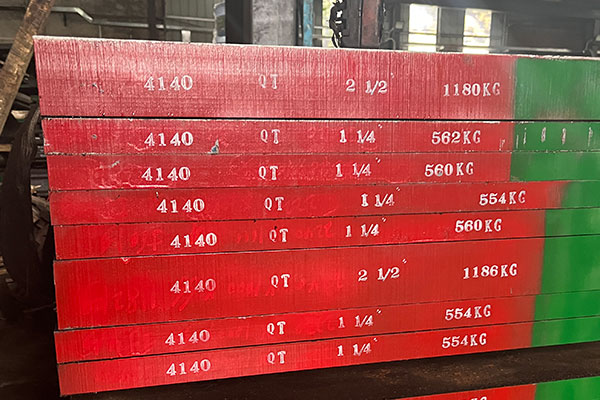
| Pre-Hardened | 28–32 HRC |
| Quenched & Tempered | 32–55 HRC |
| Induction Hardened Surface | 55–60 HRC |
| Nitrided Surface | Up to 65 HRC |
This flexibility is one of the biggest reasons why 4140 is suitable for such a wide range of industries.
Can 4140 Steel Be Surface Hardened?
Absolutely.
Although 4140 already provides excellent through-hardening capability, many manufacturers further improve surface performance through additional hardening processes.
The most common methods include:
Induction Hardening
Induction hardening rapidly heats only the surface layer.
Advantages include:
- High surface hardness
- Excellent wear resistance
- Tough core remains unchanged
- Short processing time
Typical surface hardness:
55–60 HRC
Nitriding
Nitriding introduces nitrogen into the steel surface.
Compared with induction hardening, nitriding provides:
- Higher surface hardness
- Better wear resistance
- Excellent fatigue strength
- Outstanding corrosion resistance improvement
- Minimal distortion
Typical nitrided hardness:
60–65 HRC
This makes nitrided 4140 ideal for:
- Hydraulic rods
- Gear shafts
- Extrusion screws
- Plastic machinery
- Automotive transmission components
Why Heat Treatment Makes 4140 So Versatile
What makes 4140 stand out is not just its chemical composition—it is the remarkable flexibility offered by heat treatment.
The same steel grade can be tailored for vastly different applications:
- Need excellent machinability? Choose the annealed condition.
- Need a balance of strength and toughness? Select quenched and tempered 28–32 HRC.
- Need exceptional wear resistance? Apply induction hardening or nitriding.
- Need superior fatigue performance? Optimize the tempering process.
This adaptability allows engineers to use one steel grade across a wide range of industries while meeting different performance requirements.