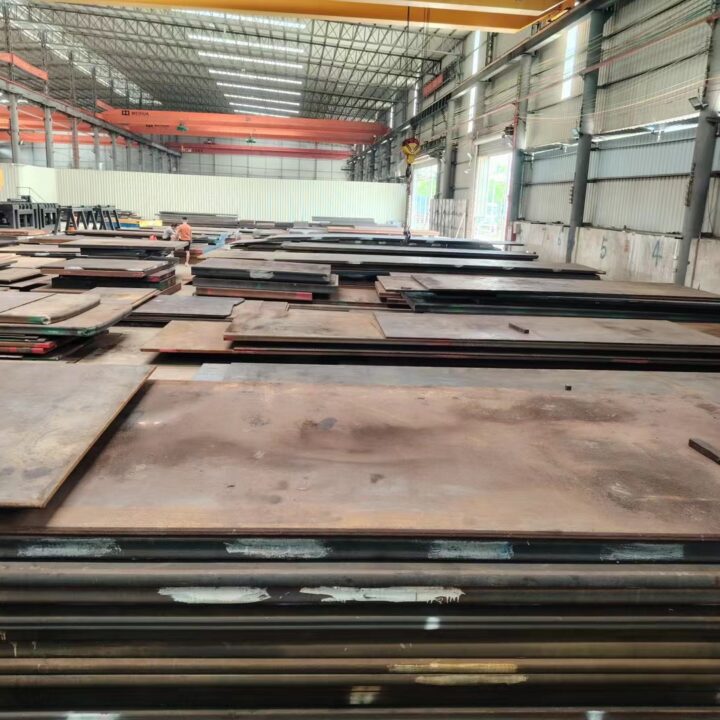
STM A36 and Chinese Q235 are both widely used carbon structural steels. Their chemical compositions and mechanical properties are relatively similar, but they are not completely equivalent.
One interesting difference is copper (Cu): ASTM A36 commonly specifies a minimum copper content of 0.20% when copper-bearing steel is required, while ordinary Q235 does not generally have this same minimum requirement.
Why does ASTM A36 contain copper? The main reason is to improve atmospheric corrosion resistance.
1. Chemical Composition Comparison
The following is a simplified comparison based on ASTM A36/A36M and GB/T 700.
| Element | ASTM A36 | Q235B |
|---|---|---|
| C | ≤0.26%* | ≤0.20% |
| Mn | ≤0.80–1.20%* | ≤1.40% |
| Si | Not universally specified | ≤0.35% |
| P | ≤0.040% | ≤0.045% |
| S | ≤0.050% | ≤0.045% |
| Cu | ≥0.20% when specified | No general minimum requirement |
*ASTM A36 chemical limits vary according to product form, thickness and applicable specification provisions. Q235 composition limits also depend on quality grade and thickness.
Important: The 0.20% copper requirement is not a universal mandatory requirement for every ASTM A36 product. ASTM A36 includes a copper-bearing steel provision, generally applicable when copper is specified by the purchaser. Check the applicable edition and purchase order.
2. Why Is Copper Added to ASTM A36?
Copper is mainly used to improve the steel’s atmospheric corrosion resistance.
Its main functions are:
1. Improve rust resistance
Copper helps steel develop a more protective oxide layer during atmospheric exposure, slowing down corrosion under suitable conditions.
2. Improve weather resistance
Copper can reduce the corrosion rate when steel is exposed to outdoor environments, such as rain and humidity.
3. Improve long-term durability
For outdoor structural applications, copper-bearing steel can offer better resistance to atmospheric corrosion than ordinary carbon steel.
However, copper is not a substitute for proper painting, galvanizing or other corrosion protection systems.
3. Does Q235 Also Contain Copper?
Yes, Q235 can contain copper, but there is an important difference.
-
ASTM A36: Minimum Cu 0.20% when copper-bearing steel is specified.
-
Q235: No general minimum copper requirement under GB/T 700.
This means Q235 may contain some residual copper, depending on the raw materials and steelmaking process, but it is not guaranteed to reach 0.20%.
4. Does Copper Make A36 a Weathering Steel?
Not exactly!
This is an important point for steel buyers.
Although copper improves atmospheric corrosion resistance, ASTM A36 is still classified as ordinary carbon structural steel.
It is not equivalent to dedicated weathering steels such as ASTM A588 or Corten steel.
The difference is that weathering steel is specifically designed with an alloying system that promotes the formation of a more stable protective rust layer under suitable environmental conditions.
A36 with 0.20% Cu does not automatically have the same corrosion resistance.
5. Final Conclusion: A36 vs Q235
| Comparison | ASTM A36 | Q235 |
|---|---|---|
| Steel type | Carbon structural steel | Carbon structural steel |
| Strength level | Similar | Similar |
| Copper requirement | ≥0.20% when specified | No general minimum |
| Atmospheric corrosion resistance | Improved when copper-bearing | Depends on actual composition |
| Weathering steel | No | No |
My recommendation for steel suppliers:
When a customer requests ASTM A36 and specifically requires Cu ≥0.20%, do not automatically offer ordinary Q235 as an equivalent.
Check the actual mill test certificate (MTC) for copper content. If the customer requires this copper level, it must be confirmed in the purchase specification.
One important distinction: 0.20% Cu is a conditional requirement in ASTM A36, not a mandatory requirement for every A36 steel product.
This distinction is particularly important when comparing Chinese Q235 with American ASTM A36.