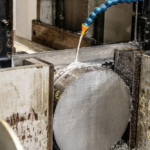
Although D2 is naturally more difficult to cut than ordinary carbon steel, proper equipment and cutting parameters can significantly improve performance.
1. Choose the Right Saw Blade
For annealed D2, a good-quality bi-metal bandsaw blade is a common starting point.
For higher-volume production or more demanding cutting conditions, carbide-tipped blades may also be considered.
The final choice depends on the saw machine, cross-section, material hardness, and production target.
Do not choose a blade simply because it is cheaper.
A low-cost blade that needs frequent replacement may result in a much higher total cost per cut.
2. Select the Correct Tooth Pitch
Tooth pitch is usually expressed in TPI, meaning teeth per inch.
The correct TPI depends on the workpiece dimensions and the number of teeth engaged in the cut.
For solid D2 bars, customers should consult the blade manufacturer’s tooth-pitch chart rather than using the same blade for every diameter.
As a general principle:
- Smaller sections normally require a finer tooth pitch.
- Larger solid sections normally require a coarser tooth pitch.
- The blade should maintain suitable tooth engagement throughout the cut.
- Avoid conditions where too few teeth carry excessive cutting loads.
For D2, the blade manufacturer’s recommendations for hard tool steels should take priority over general carbon-steel cutting charts.
3. Adjust Cutting Speed and Feed Pressure
Using excessive cutting speed can generate unnecessary heat and accelerate blade wear.
However, simply reducing feed pressure too much is not always the solution.
If the teeth are not cutting properly and only rub against the material, cutting efficiency may decrease and heat generation may increase.
The goal is to find a stable combination of:
- Blade speed
- Feed pressure
- Tooth pitch
- Coolant supply
- Machine rigidity
Start with the blade manufacturer’s recommended parameters for annealed tool steel, then make controlled adjustments based on actual chip formation and cutting performance.
4. Use Proper Coolant and Lubrication
Coolant helps control temperature and remove chips from the cutting area.
Insufficient coolant may contribute to excessive heat, poor chip evacuation, and premature blade wear.
Customers should check:
- Coolant concentration
- Coolant flow rate
- Nozzle position
- Whether coolant reaches the actual cutting zone
- Coolant cleanliness and filtration
A suitable coolant system is particularly important when cutting larger D2 sections or performing continuous production cutting.
5. Break In New Saw Blades Properly
A new bandsaw blade should not always be operated immediately at full production feed.
The tooth edges are initially very sharp. A controlled break-in process helps establish a stable cutting edge and reduce premature tooth damage.
A practical approach is to:
- Set the blade speed according to the manufacturer’s recommendation.
- Begin with a reduced feed rate.
- Allow the blade to cut a suitable initial area.
- Gradually increase the feed rate.
- Monitor chip formation and vibration.
The exact break-in procedure should follow the blade manufacturer’s instructions.
6. Check Machine Condition
Even a high-quality blade may have a short service life if the bandsaw machine is not operating correctly.
Check the following:
- Blade tension
- Blade guide alignment
- Saw wheel condition
- Workpiece clamping
- Machine vibration
- Feed mechanism
- Coolant delivery
A stable machine setup is essential for cutting hard and abrasive tool steels.