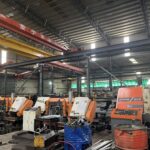
Many steel stockists, machine shops, and tool manufacturers report a common problem:
D2 steel is difficult to cut, consumes bandsaw blades quickly, and sometimes takes much longer to process than expected.
Some customers even report that cutting D2 steel wastes more money on saw blades than they initially anticipated.
Why does this happen? Is D2 naturally difficult to saw?
Reason 1: High Carbide Content Causes Abrasive Blade Wear
This is one of the most important reasons.
D2 contains a relatively large volume of chromium-rich carbides. These hard particles improve the steel’s wear resistance during service, but they also act as abrasive particles against the saw blade.
During cutting:
- The saw blade teeth penetrate the steel surface.
- The cutting edges encounter hard carbide particles.
- Repeated contact gradually wears down the tooth tips.
- The teeth lose their sharpness and cutting efficiency.
- Cutting time increases, and the blade may eventually need replacement.
This explains why some customers experience rapid bandsaw blade consumption when cutting D2.
The problem is not necessarily that the steel is defective. It is partly related to the fundamental metallurgical characteristics of the grade.
Reason 2: D2 Has High Hardness, Even in the Annealed Condition
D2 is normally supplied in an annealed condition for machining before final heat treatment.
Depending on the supplier and specification, its annealed hardness is commonly around 200–250 HB, with some technical datasheets specifying a maximum of approximately 250 HB.
Although this is much softer than its hardened working condition, it is still relatively difficult to machine compared with common structural or carbon steels.
For comparison:
| Steel Grade | Typical Delivery Condition | General Sawing Difficulty |
|---|---|---|
| 1045 / C45 | Normalized or untreated | Relatively easy |
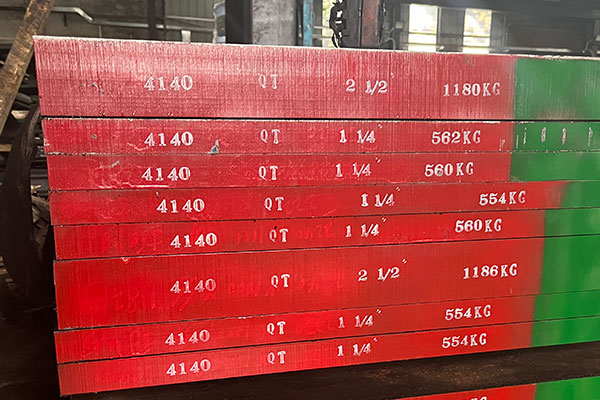
| 4140 / 42CrMo4 | Annealed or pre-hardened | Moderate |
| 1.2311 / P20 | Pre-hardened | Moderate to difficult |
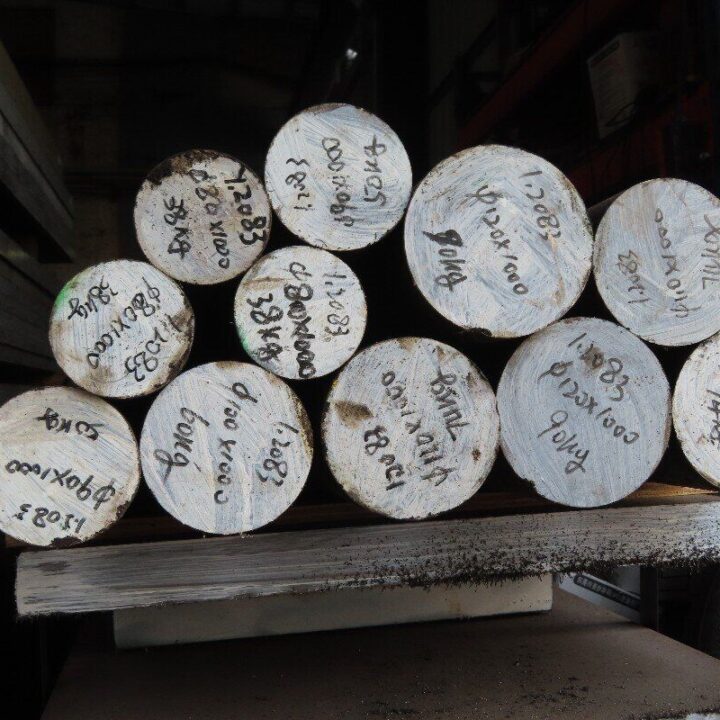
| D2 / 1.2379 | Annealed | Difficult |
| D2 / 1.2379 | Hardened | Extremely difficult for conventional bandsawing |
This is a general comparison, not a fixed ranking. Actual performance depends on hardness, section size, equipment, blade type, and cutting conditions.
Customers sometimes assume that all annealed tool steels should be easy to cut. However, D2 is different because of its high alloy and carbide content.
Reason 3: The Material May Not Be Fully Annealed
This is an important point when investigating unexpected cutting difficulties.
D2 should normally be supplied in an annealed condition for conventional machining.
If the material has not been properly annealed, its hardness may be higher than expected, making cutting more difficult.
Possible issues include:
- Incomplete annealing
- Non-uniform hardness across the section
- Localized hard areas
- Previous heat treatment or improper thermal processing
- Surface conditions that affect cutting performance
If one batch of D2 cuts significantly worse than another batch of the same nominal size, checking the actual hardness is a sensible first step.
A hardness test can help determine whether the material condition is consistent with the agreed supply specification.
However, hardness alone does not explain every difference in cutting performance. Carbide distribution, steelmaking quality, and the sawing setup can also contribute.
Reason 4: Carbide Distribution and Steelmaking Quality
Not all D2 steel necessarily has identical microstructural characteristics.
The distribution and size of carbides can vary depending on the steelmaking and processing route.
In conventional high-carbon, high-chromium tool steels, carbide segregation and non-uniform carbide distribution may affect local machining behavior.
If the carbide distribution is particularly uneven, customers may experience inconsistent cutting resistance across the material.
For example:
- One section may cut relatively smoothly.
- Another section may produce faster tooth wear.
- Cutting performance may vary between different production batches.
This does not mean that every difficult-to-cut D2 batch has a metallurgical defect.
However, if a customer repeatedly experiences abnormal blade consumption with the same supplier or heat number, it is worth investigating the material’s hardness, microstructure, and manufacturing history.
Reason 5: Incorrect Saw Blade Selection
Another common reason is using a blade designed for ordinary carbon steel to cut D2 tool steel.
A standard blade may work well on 1045 or S355 but may not perform efficiently on D2.
The blade must be selected according to:
- Material hardness
- Material cross-section
- Round bar or flat bar geometry
- Sawing machine capacity
- Required cutting speed
- Production volume
For D2, customers should consider industrial-quality bi-metal blades or carbide-tipped blades, depending on the material condition and production requirements.
The correct tooth pitch is also important.
If the teeth are too coarse, individual teeth may carry excessive loads. If the teeth are too fine, chips may not clear effectively and the blade may rub instead of cutting efficiently.
Blade selection should follow the blade manufacturer’s recommendations for the actual cross-section and material condition.
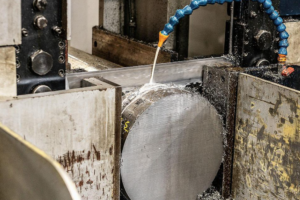
Contact Otai for D2 / 1.2379 Tool Steel
Looking for D2 tool steel in round bars, flat bars?
Contact Dongguan Otai Metal Material Co., Ltd. for material availability, technical specifications, and quotations.
Email: rika@otaisteel.com
WhatsApp: +86 136 4282 5398
We welcome inquiries from steel stockists, tool manufacturers, machining companies, and industrial distributors worldwide.